Spider Solitaire Card Games
- 4.9
- Rating
- 100.00K
- Installs
- Free
- Price

 Analysis by App-foxy
I like card games that respect a short break. They should be easy to understand, quick to start, and interesting enough to make me think without demanding a long session. Spider Solitaire Card Games fits that description as a focused card game from Card Games, Inc. It takes the familiar Spider Solitaire format and keeps the experience centered on arranging cards, clearing sequences, and deciding when a move is worth making.
That narrow focus is both its appeal and its limitation. If you want a calm solo puzzle for a commute, a waiting room, or a few quiet minutes before bed, this is an easy game to consider. If you are looking for a broad collection of different card games, a social experience, or a highly elaborate challenge system, you may prefer a different kind of card app. My recommendation depends less on whether you already know Spider Solitaire and more on what you expect from a mobile game.
What to consider before choosing it
The first question is whether you enjoy games built around planning rather than speed. Spider Solitaire gives me time to examine the layout and think through the consequences of each move. There is no need to react instantly, so the challenge comes from recognizing useful sequences, protecting future options, and avoiding choices that leave the tableau blocked.
You May Also Like

 Blood Strike: 2.5 Anniversary
Blood Strike’s Loadouts Turn Every Drop Into a Tactical Gamble
A close look at Blood Strike’s custom loadouts: how fast access to signature weapons reshapes its battle royale rhythm, rewards preparation, and narrows the gap between fights.

 Pandora - Music & Podcasts
Pandora’s Music Is Easy to Start, but Harder to Recover
Pandora’s strength is its low-effort path from a seed to a station. Its weak spot is how much confidence it asks you to place in connection, setup, and quiet recovery.

 8 Ball Pool
 Is Built on Rivalries, Rematches, and Routine
A close look at the rivalries, rematches, shared routines, and unanswered safety questions that turn a quick pool match into a persistent mobile community.

 Samsung Music
’s Quiet Strength Is Playing What You Already Own
Its reach comes less from spectacle than from dependable access to a personal library. That simplicity is both the app’s strongest retention engine and its ceiling.

 AccuWeather: Weather Radar
AccuWeather Review: A Quick, Clear Forecast for Everyday Decisions
For everyday plans, the best forecast is the one you can understand quickly. AccuWeather makes rain timing, radar, and local conditions easy to act on, with a few trade-offs.

 Hill Climb Racing
Why Hill Climb Racing Still Turns Crashes Into One More Run
A tiny car, a bumpy hill and one more upgrade: Hill Climb Racing keeps resurfacing because its simple chaos makes every near-miss feel personal.
More From Our News Desk
View All News


The game is free, carries an Everyone age rating, and works on devices running Android 6.0 or later. Those details make it approachable for a wide range of players, including someone who wants a straightforward game on an older compatible phone. I would still judge it by the playing experience rather than by accessibility alone: a low barrier to entry matters only if the game remains comfortable after the first few rounds.
Another useful decision criterion is commitment. Spider Solitaire Card Games is not the kind of title I would choose when I want a story, a changing world, or a large set of activities. Its value comes from repetition with variation. Each layout asks me to apply the same general rules in a different situation, which can feel soothing to one player and predictable to another.
The game was released on February 19, 2024, and its current version is 1.2.6. I see that version information as useful when deciding whether the app is suitable for a device, but it does not change the central question: do you want a dedicated Spider Solitaire experience or a larger card-game package?
How the central puzzle feels in everyday play
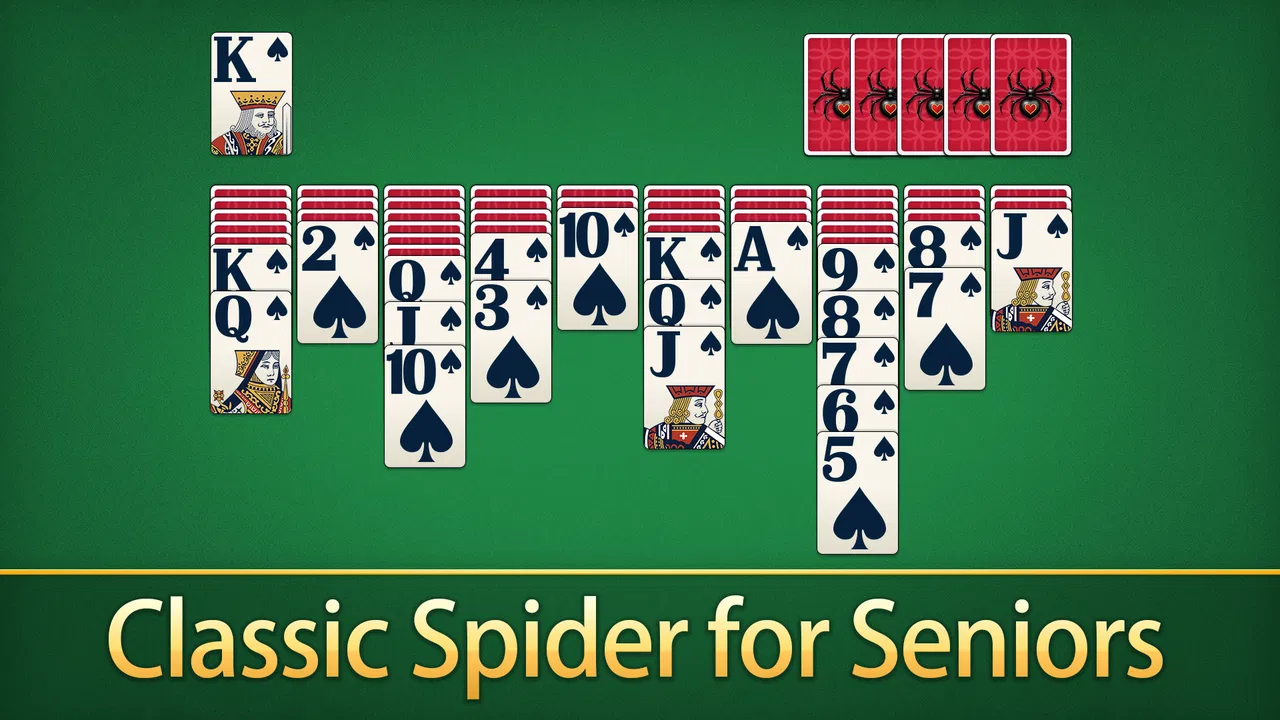
In a typical round, I start by scanning the visible cards instead of immediately moving the first available sequence. That small habit makes a noticeable difference. A move that looks helpful may uncover a card but also break a useful run, while a less obvious move can open a column and create room for several later decisions.
My preferred way to play is in short stages. I first look for cards that can be placed into descending order, then check whether a move exposes a hidden card or creates an empty space. Empty columns are especially valuable because they give me somewhere to temporarily place a sequence while I reorganize the tableau. Treating them as storage rather than simply as a sign of progress makes the game feel more strategic.
This is one of the app’s stronger everyday qualities: it turns a small amount of free time into a contained thinking exercise. I can play a few moves while waiting for an appointment, stop without losing the sense of what I was doing, and return later when I want another puzzle. It does not require the emotional investment of a competitive game, which is exactly why I find it suitable for quiet breaks.
There is also a useful trade-off in the simplicity. Because the game stays close to the classic format, I spend more time thinking about the cards and less time learning menus, currencies, characters, or layered objectives. On the other hand, players who need constant novelty may eventually feel that the basic loop does not change enough.
Small decisions that improve the experience
A practical tip is to avoid filling an empty column too quickly. I try to use that space to uncover difficult cards or rearrange a long sequence, rather than placing the first convenient card there. The extra flexibility can be more valuable later than the immediate satisfaction of making a neat-looking stack.
I also pay attention to hidden cards before completing a visible sequence. Finishing a run can look like obvious progress, but keeping a sequence available may allow me to move it as a unit and reveal a card underneath. This is the sort of decision that separates a thoughtful round from a series of automatic taps.
Another useful approach is to delay dealing new cards until the current layout has given me as much information as possible. Adding more cards can create fresh possibilities, but it can also cover the options I was preparing to use. I find it better to treat a new deal as a deliberate change in the puzzle, not as something to do whenever I run out of immediate moves.
These habits are not complicated, yet they give the game more depth than its simple appearance suggests. They also make it more suitable for someone who wants a light mental workout rather than a purely passive distraction. The challenge comes from managing future choices, not from tapping quickly.
Where this version wins
The clearest strength is focus. Spider Solitaire Card Games does not ask me to navigate a large collection before reaching the actual game. For a player who already knows the format, that directness is valuable. I can open it with a specific intention: play Spider Solitaire, think through the layout, and stop when I am finished.
That focus also makes the app easier to recommend to someone who has never played Spider Solitaire. The basic idea is understandable through the card arrangement itself, and the game’s familiar structure gives a new player a natural path into the rules. I would still expect a beginner to need a few rounds before planning several moves ahead, but the learning curve feels manageable rather than intimidating.
The rating and audience figures suggest that the game has attracted a substantial group of players: it holds a 4.9 average from around 11 thousand ratings, with over 100 thousand installs and 567 reviews. I would not treat popularity as proof that every player will enjoy it, but those figures do make it easier to see the app as an established choice rather than an obscure experiment.
Its free price is another practical advantage. Someone curious about Spider Solitaire can try it without committing money first. That matters particularly for casual players who may play only occasionally. The free entry point makes the decision simple: install it, spend time with a few rounds, and decide whether the repetition feels relaxing or dull.
I also appreciate the game’s suitability for different levels of attention. I can play carefully when I want a proper puzzle, or make a few simple moves during a brief pause. It does not need to dominate my afternoon. That flexibility is more useful than it sounds because many mobile games are designed around longer sessions or constant engagement.
Who will get the most from it
I would recommend it first to people who already enjoy solo card games and want a dedicated Spider Solitaire option. It is also a good fit for players who like organizing information, spotting patterns, and making decisions with incomplete access to the board. The game rewards patience more than reflexes, so it can be a pleasant alternative to fast arcade titles.
It may suit families as well because of the Everyone age rating and the familiar card format. A younger player can approach it as a matching and ordering exercise, while an experienced player can focus on planning several moves ahead. The same layout can therefore support different levels of attention, even though the underlying rules remain consistent.
My most realistic use case is a short evening break. I might play one round after finishing work, not because I need a major distraction, but because I want an activity that occupies my hands and gives my mind a small problem to solve. Unlike scrolling through unrelated content, the game gives that time a clear beginning and end.
It is also useful when I want a game that does not depend on another person being available. There is no need to coordinate a match or wait for an opponent. That makes the app a reliable choice for solo play, especially when I want something more engaging than watching a video but less demanding than starting a large game.
The trade-offs inside a simple design
The same focused structure that makes the app accessible can make it feel limited. If you expect several card variants, a campaign, or a strong sense of progression, the classic Spider Solitaire loop may not provide enough variety. I would not install this expecting it to replace an entire card-game collection.
There is also a mental trade-off between calm and repetition. The game can be relaxing because the rules are stable, but that stability means the experience depends heavily on whether you enjoy solving similar types of layouts repeatedly. Players who need frequent changes in goals or presentation may lose interest sooner than players who enjoy refining their approach.
Another limitation is that the game asks me to create my own motivation. In a story-driven game, the next chapter or objective provides momentum. Here, the motivation is internal: I want to clear the layout, improve my decisions, or simply spend a few quiet minutes. That is satisfying for some players, but it will not suit everyone.
For that reason, I would skip it if your main goal is social play, competition, or a broad set of card rules in one installation. I would also look elsewhere if you want a game that constantly introduces new systems. Spider Solitaire Card Games is strongest when its narrow purpose matches your expectations.
How it compares with other card-game choices
The most obvious alternative is a general solitaire collection. Those apps can be better when I want to switch between Spider, Klondike, FreeCell, and other familiar formats without changing applications. Their advantage is variety; their drawback is that the experience may feel less direct when I already know exactly which game I want.
A traditional physical deck offers a different kind of flexibility. I can use it for many games and play with another person, which this solo mobile format cannot replace. However, a phone is more convenient when I am alone, traveling light, or do not have a table available. The choice is not really about which is universally better; it is about whether convenience or shared play matters more at that moment.
Some digital alternatives focus on competition, timed rounds, leaderboards, or online opponents. Those can provide stronger pressure and a clearer reason to return, especially for players who enjoy measuring performance against others. I prefer this app when I want control over the pace and no social obligation. The quieter format is a strength for relaxation, but a weakness for anyone who needs rivalry to stay interested.
Puzzle games outside the card category may offer more visual variety and more elaborate progression. They can be a better choice when I want new mechanics every few minutes. Spider Solitaire has the advantage of familiarity: I spend my attention on planning card movement instead of learning a new rule set. That makes it easier to pick up, though not necessarily more exciting over a long period.
What switching really means
Moving from another solitaire app to this one should be relatively easy if your main preference is Spider Solitaire itself. The rules and basic thought process are familiar, so the real adjustment is deciding whether this app’s focused presentation gives you enough reason to stay. I would test it during the kind of break when I normally play, rather than judging it after only a quick opening session.
The cost of switching is higher for someone who relies on a large collection of variants. In that case, changing to a dedicated Spider Solitaire game means giving up the convenience of having several formats in one place, even if the individual Spider experience feels more direct. I would keep a broader collection if variety is part of my regular routine.
There is also a habit cost. If you already know where everything is in another app, a new interface can briefly slow you down. That is not a major concern here because the core game is familiar, but it is still worth remembering: convenience includes the time spent adapting, not just the time spent playing.
For a new player, however, there is little reason to overthink the switch. The free price makes experimentation straightforward, and the Android requirement covers devices running version 6.0 or newer. I would install it, play several complete rounds, and pay attention to whether I enjoy planning the board or merely enjoy the novelty of a new app.
My recommendation for different players
I recommend Spider Solitaire Card Games to anyone who wants a quiet, free, solo card puzzle with a familiar structure. It is especially appealing if you value direct access, patient decision-making, and short sessions that do not require a connection with other players. The app’s strong average rating and broad install base support its credibility, but my main reason to recommend it is the match between its simple purpose and those needs.
I would choose a broader solitaire collection instead if I regularly move between several card games. I would choose a competitive card app if I need opponents, rankings, or pressure. I would choose a richer puzzle game if I want constant changes in mechanics. Those are not failures of this title; they are situations where its focused design is simply the wrong tool.
For me, the best way to use it is to treat each round as a short planning exercise. I scan before moving, protect empty columns, uncover hidden cards deliberately, and avoid dealing new cards until the current options are exhausted. Those small choices turn a basic card layout into a more satisfying mental routine.
Card Games, Inc has kept the experience centered on what makes Spider Solitaire appealing in the first place: arranging cards, weighing consequences, and enjoying a puzzle that can be paused whenever life interrupts. It is not a complete card-game universe, and it does not need to be. If you want one dependable Spider Solitaire game rather than a collection of distractions, this is the version I would try first.
My final view is positive but specific. Install it for calm solo play, a familiar challenge, and flexible short sessions. Skip it when variety, competition, or social interaction matters more than a clean Spider Solitaire loop. For the right player, that narrow focus is not a weakness; it is exactly what makes the game worth keeping.
FAQs for Spider Solitaire Card Games
01What features does Spider Solitaire Card Games offer?
Spider Solitaire Card Games offers a variety of features to enhance the classic gaming experience. You can enjoy different difficulty levels, customize themes and card designs, and compete in daily challenges. The app also includes a hint system to help you improve your skills and a leaderboard to track your progress against other players.
02Is Spider Solitaire Card Games free to download and play?
Yes, Spider Solitaire Card Games is free to download and play. However, it may include optional in-app purchases to enhance your gaming experience. These purchases can unlock additional features, remove ads, or provide extra hints. You can enjoy the basic gameplay without spending any money.
03Does Spider Solitaire Card Games require an internet connection?
Spider Solitaire Card Games can be played offline, so you don't need an internet connection to enjoy the game. This makes it a perfect choice for playing on the go, whether you're on a flight or in an area with limited connectivity. Some features, like leaderboards, may require a connection.
04Can I customize the appearance of the cards and background?
Yes, Spider Solitaire Card Games allows you to customize the appearance of both the cards and the background. You can choose from a variety of card faces and back designs, as well as different themes for the game board. This feature lets you personalize the game to suit your style and preferences.
05Is Spider Solitaire Card Games suitable for all ages?
Spider Solitaire Card Games is suitable for players of all ages. Its intuitive interface and adjustable difficulty levels make it accessible for beginners and challenging for experienced players. The game is designed to be family-friendly, offering a safe and enjoyable experience for everyone.
Pros
- User-friendly interface enhances gameplay.
- Multiple difficulty levels for all players.
- Offline mode available for uninterrupted play.
- Daily challenges keep the game engaging.
- Visually appealing graphics and animations.
Cons
- Contains ads that may interrupt gameplay.
- Limited customization options for card decks.
- No multiplayer mode available.
- In-app purchases can be costly.
- Battery consumption could be optimized.

Spider Solitaire Card Games
Gallery